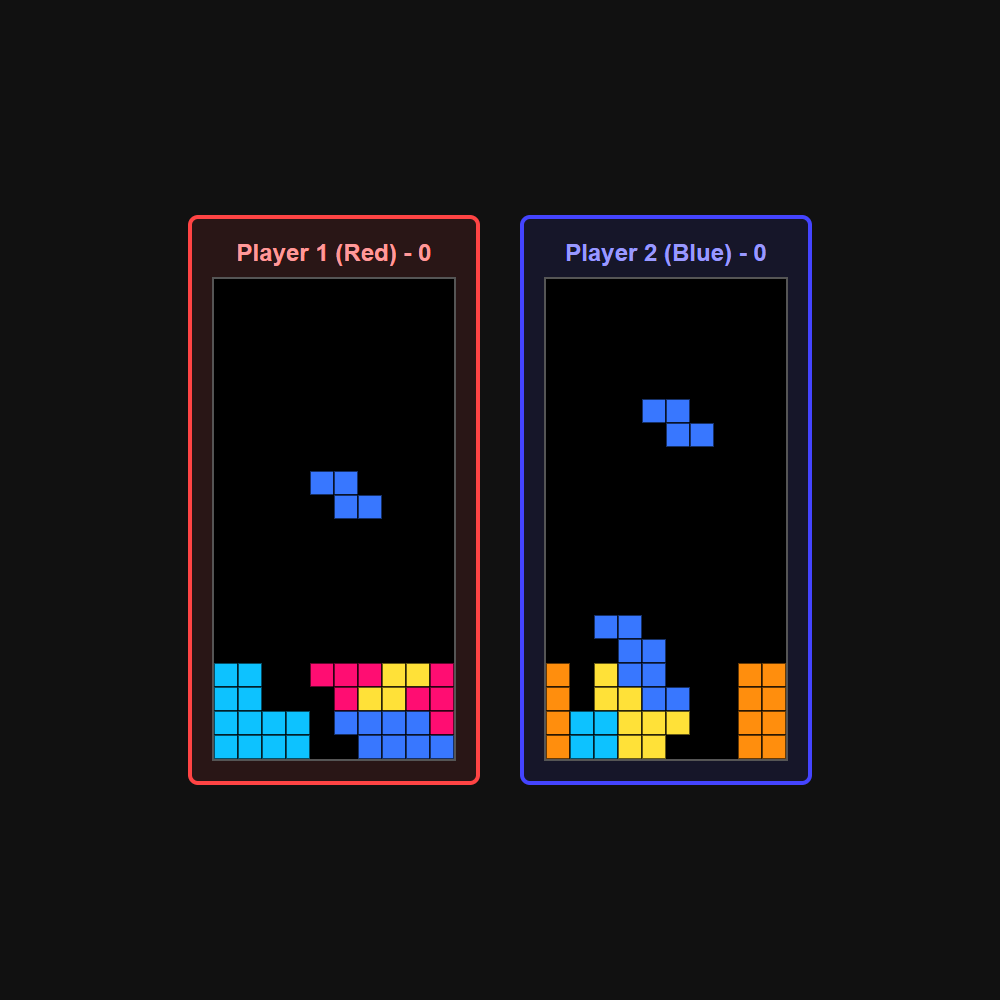
Tetris is an early RCWeb asymmetric prototype that puts two independent Tetris boards on one shared display while phones act as dedicated controllers. It is less interesting as a full game than as a developer example of how early RCWeb apps handled joining, role assignment, and targeted controller updates using plain JavaScript messages.


The viewer renders two separate Tetris matrices side by side. The first connecting controller becomes Player 1, the second becomes Player 2, and each board runs its own arena, falling piece, score, and game-over flow. The mechanics are classic: move, rotate, hard drop, clear lines, and speed up through score progression.
As an RCWeb example, the main value of this app is that it shows how a display can reserve named roles instead of treating every phone as an identical participant. It is a small prototype, but it demonstrates one of the most common asymmetric patterns in RCWeb: the viewer decides who occupies each seat, then pushes targeted UI changes back to those controllers.
Tetris uses an older raw-message approach rather than a later structured snapshot approach:
/tetris/ and owns both player states./tetris-control/.rc.send(js, "!" + rc.client).Joining is handled by the controllers themselves:
player id locally.rc.send("tetris.join(" + player + ");", "tetris").Once assigned, the viewer sends targeted UI commands back to controllers:
controls.setTheme("red" | "blue" | "default")controls.setScore(score)Those updates are targeted by embedding the assigned player id into the outbound JavaScript and sending it to the controller app. That means the controller app is partly a remote-rendered UI surface controlled by the viewer.
For a developer building a similar RCWeb app, this prototype demonstrates:
Tetris is a good reference when your RCWeb app needs fixed seats rather than open-ended drop-in entities. The flow is simple:
moveLeft, moveRight, rotate, and hardDrop.Compared with later RCWeb apps, this prototype is more manual and string-driven, but that is exactly why it is useful. It shows the underlying communication model very clearly: RCWeb is just room-aware JavaScript dispatch, and even a simple two-seat arcade game can be built on top of that with very little machinery.